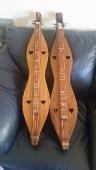
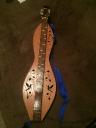
"Angel" Will Singleton Replica
Instruments- discuss specific features, luthiers, instrument problems & questions
That's a nice one, John! Need more Singletons out there! Real nice meeting you at Berea!
That's a nice one, John! Need more Singletons out there! Real nice meeting you at Berea!
Yes, here is a photo of the original in Lexington, Kentucky. The folksinger John Jacob Niles altered the fret pattern, but I used the normal diatonic pattern for my replica.
Wow what a beautyfull instrument. Do you have a picture of the original?
I am happy to hear that you have followed my suggestion to contact Martin of the German dulcimer shop in Ludwigsburg. I am looking forward to your sound/film example.
Congratulations on your dulcimer purchase. I hope you know that Martin is also a member here.
And even though I am in the US, when I started playing I also relied on videos by Bing Futch and others.
Think there ar a lot ho teach themselfs this way. I do like way Brett teach.
Nice! We need more dulcimer players in Europe. :) Have fun!
Absolute.. Hope more will follow.
I'm happy to hear you wound up getting something you like! We look forward to getting a peek at what you are up to when you can. Don't worry about not being an expert player- almost no one is anyway, we mostly play for enjoyment. :)
This is my way to play. Fun only. No musts. I have to many musts on the job and so on. Playing is relaxing for me. Don't mather what and how long.
I will post a video this weekend i hope. :)
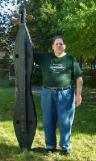
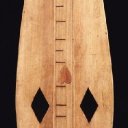
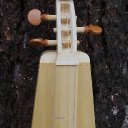
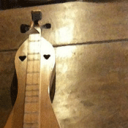
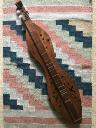
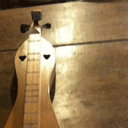
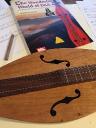
Here's a new Uncle Will Singleton dulcimer replica I built for a player in Toronto. Its name is "Angel", taken from Psalm 34:7. Singleton was the local dulcimer builder in Viper, KY and was related to Jean Ritchie. The poplar body really rings out when played. The red heart and diamond are cherry inlays in the fretboard.
I suspect for "under $150" that the Red Mountain kit is gonna be as good as it gets. Not a great instrument, but a serviceable.
Folkcraft kits are $260-275.
McSpadden has its Sweet Song Kit -- flat head hourglass shape -- for $155 which would be a better choice IMHO than the Cedar Creek -- better sounding and lighter weight...
Cedar Creek Dulcimers has a Red Meadow kit starting at $139.99. Red Meadow & other kits I have the Classic Walnut kit (shown at the top of the page) made as a chromatic dulcimer. I did not put the kit together myself and had them put the grooves for the frets & the sound holes in, which cost more. A 91 year old gentleman put the kit together for me and I tried to make it easier for him. The dulcimer sounds good. It is heavier than my diatonic dulcimer which is what I usually play. Scroll down on the page to click on the Red Meadow kit.
Who all makes a decent quality dulcimer kit for a low price, preferably under $150?
LisavB. I'm glad you decided to join us. You will find this forum to be warm and friendly. We are united by our love for the dulcimer, and we are glad you decided to join us. If you have any questions or wish to share more of your journey with the dulcimer, we'd love to hear more from you.
Hi, I'm Lisa. I fell into the dulcimer completely by accident, and fairly recently. I like making things and my BF keeps teasing me about making a harpsichord for him when I/he retire. Last November, I thought it wise to start with something smaller, and looked on the Internet. Hah, I could make a cardboard dulcimer! Not costly, and I could paint it with my own design. If something terrible happened, not a lot lost. Oh, and they said it was easy to play, so maybe I could try playing it.
So I made one from Backyard Music. Sounds pretty good for a basic cardboard guy. Painted it with an art deco motif, forest green and peach. And I started to play. And it was fun...and...
Then I wanted to try building a solid wood one. Finally gave in and ordered a black walnut kit from Cedar Creek Dulcimers. I was terrified--such nice wood to screw up! But I did it, and I love it! And wow, the sustain with solid walnut.
I love the dulcimer because there are so many ways to play it (noter, pick, fingers, melody string only, strum only, pick individual notes, chords), seems like you can keep learning and trying new things nearly endlessly. Took the cardboard one on vacation to Canada recently. Got to sit by the side of a lake we had all to ourselves (camping) and just improvise. Wonderful! (Cardboard one is good to take where there is a chance of getting a ding...)
Hi Fatcat, we're happy you found us too!! 
I hope your health improves to allow you to enjoy playing your music at home. 
Well, he still has an ebay account so I sent him a message there. So we'll see. Thanks so much, Robin.
Michael, it has been several years since I've even read anything about Darcyhorse Dulcimers. . . I wish you luck with your query!
Would anyone happen to have the contact information for Darcyhorse Dulcimers? I purchased a Darcyhorse Dulcimer a few years ago. I would like to contact the builder, but I no longer have his contact info. Thanks!
Hi again Andreas, and welcome 'back' to the site again! It's good to see you check in here. I hope your health improves and that you continue to enjoy playing music on whatever instruments inspire you. 
I do need to mention that the email address you have set in your account settings here does not function and you need to go into your account settings and change it to a different, working email address, and then hit the 'save' button. As it stands now with that nonworking email, you will not be receiving any emails or notifications from fotmd that would normally let you know about any private messages, comments on your profile page, friend requests, likes, or replies to your posts. It'd be great if you can change to a working email address in your fotmd account- thanks!
Congratulations on your dulcimer purchase. I hope you know that Martin is also a member here.
And even though I am in the US, when I started playing I also relied on videos by Bing Futch and others.
I am happy to hear that you have followed my suggestion to contact Martin of the German dulcimer shop in Ludwigsburg. I am looking forward to your sound/film example.
Nice! We need more dulcimer players in Europe. :) Have fun!
I'm happy to hear you wound up getting something you like! We look forward to getting a peek at what you are up to when you can. Don't worry about not being an expert player- almost no one is anyway, we mostly play for enjoyment. :)
Hi Guys. Was a long time, but I do find a nice Dulcimer. I bought one in Germany. http://www.dulcimer-online.de/
I bought this type. https://www.dulcimershop.de/konzertdulcimer.html
I would thank you all for youre kind help and as you can see. It wasn't for nothing. Now I am teaching myself to play. With the help of Brett Ridgeway and Bing Futch Because They have online lessons. I pay for these lessons on Patreon. Wonderfull website. We don't have that in the Netherlands.
I will post a little picture and a sound/film example. But don't judge my abillitys. I am a student and learning. :)
Garret, I don't own a Bear Meadow dulcimer, but I have two friends who have them and swear by them. One actually owns two. Their action rivals that of any other high-end dulcimers. Their volume is not as great as the other really LOUD dulcimers out there (I have three that are probably louder: Modern Mountain Dulcimer, Rick Probst, and Terry McCafferty) but the Bear Meadows have a tonal balance that puts all the others to shame. Most dulcimers tend to privilege either the high tones or the bass tones, but Bear Meadow dulcimers are just exquisitely balanced.
Dwain has posted some sound samples on the website . Give them a listen.
Hello, All,
I am curious about the Bear Meadow hourglass dulcimers, those with a 27 5/8" vibrating string length. Can anyone tell me how their timbre, attack, sustain, volume, and overall tone compare with the traditional McSpadden dulcimers? Thanks!
Hello all,
This is my first post--I'm very excited to be here! The dulcimer bug has me firmly in its grasp...
I have a Backyard Music cardboard dulcimer I made several months ago, as well as a Cedar Creek Walnut Classic I built more recently. I initially strung up the walnut one in DAD, and found the melody strings very, very hard to press down. Tuned it down to DAA and that's much better. I got several different sets of strings in different gauges with the intent of optimizing the cardboard guy to DAA and the walnut to DAD (has 6 1/2 fret, so better to take advantage of that for DAD).
While I'm not afraid of restringing, I don't want to do it every 10 minutes, either. The question I have is whether I can swap strings between the two or, more generally, if it's OK to reuse strings if they aren't too old, or if once you string them, you should not attempt to restring them. (And while I'm at it, how old is old?)
Thanks!
Strings are not expensive. As Robin states, try a set and change back and forth and see which ones suit you and your playing style. You should be able to find some which will tolerate moving between DAA and DAd and be quite satisfactory in sound in either mode.
@foundryrat Perhaps just give .012's a go and tune and re-tune to see whether it suits?
I understand why, ideally, string gage will vary with the tuned pitch, but what if you want the capability to shift between DAA and DAd? String for DAd and put up with potentially slack melody string for DAA or "cheat" a little bit on the melody string gage and make it .001 heavier?
I enjoy seeing the responses, folks!
Playing mountain dulcimer with a noter is all I know-- I enjoy it tremendously! And there are MD players who play styles of music I enjoy yet could never hope to play. If a chromatic mountain dulcimer is what is called for to play the music a dulcimer player wants to make, then a chromatic fretboard it must be! :)
With both dulcimers and banjos, I don't necessarily see it as all about the number of frets or non-frets, but more a matter of the style the instrument is played in, which is usually closely connected to the repertoire (but doesn't always have to be).
I have diatonic epinettes, mtn dulcimers with one or a few extra frets, a chromatic langspil, and both (chromatic) fretted banjos and fretless banjos. They're ALL great for doing various things- playing in various playing styles, playing repertoire from different time periods or different music cultures and genres. Each one has its own wonderful charms. If you have diverse taste in music, it's great to have a selection of instruments/tools to get the effect you're after!
I wonder if the same conversations, etc., occur concerning fretted and fretless banjos.
I did an experiment back when I first added a plus fret and repeated it with my first chromatic MD. I played a couple of tunes on my diatonic, then on the one with the added fret and the chromatic. They all sounded and played the same, by golly [and my other half couldn't tell the difference].  I don't use a noter though, and that can make a bit of difference because of the extra 'bumps/thump's.
I don't think it's so much that it sounds like a guitar. The logic is basically "If you want to play a fully chromatic instrument, why don't you just play an instrument like a guitar (or banjo or mandolin, etc.) that is already chromatic?"
The purists would say that the diatonic fret pattern is a defining feature of the dulcimer. As you begin to change one of the dulcimer's defining characteristics, the instrument is moving away from being a dulcimer and transitioning into a hybrid instrument. Not a guitar exactly, but beginning to look and play more like a guitar and less like a dulcimer.
To get the sound of a guitar, you would need to increase the size of the dulcimer's soundbox, extend the neck/fretboard beyond the soundbox, increase the number of strings, and adjust the gauges of the strings. Each of these changes is a movement in the direction of the guitar and away from the dulcimer.
If the only change made is to fret the dulcimer chromatically instead of diatonically, then the instrument will still sound more like a dulcimer. However, it will have some of the playing features of the guitar.
Some Common Features of Each Instrument:
Dulcimer = Smaller Soundbox, Diatonic Fretboard, Fretboard Does Not Extend Beyond Soundbox, Fewer Strings, Lighter Gauge Strings, Played on Lap with Fretboard Facing Up
Guitar = Larger Soundbox, Chromatic Fretboard, Fretboard/Neck Extends Beyond the Soundbox, More Strings, Heavier Gauge Strings, Played with Hand Reaching Under and Around the Neck
Putting a chromatic fretboard on a dulcimer body without changing any other features results in a chromatic dulcimer. Not exactly a guitar, but a step in that direction.
Incidentally, there is nothing wrong with playing an instrument modified from its traditional form. Likewise, there is also nothing wrong with preferring to keep the instrument in its purest, most traditional form. To each their own. What you play and how you play it are decisions to be made by each individual. Basically, if you enjoy playing it, that's all that's necessary.
I never did understand it when people say if you put extra frets on a dulcimer, it sounds like a guitar. If you put extra frets on a mandolin does it sound like a guitar? Oh wait... the mandolin already has extra frets! So do banjos and ukuleles. None of them sound like guitars to me.
Now if somebody wants to make the argument that playing chords instead of drones makes the dulcimer sound like a guitar, well I still disagree but I can understand where they're coming from.
[/quote]
That can sometimes be attributed to a string that is not tight enough for the note it's being tuned to. With a slightly too slack string, your finger pushes the string right down to the wood much more easily, bending/pulling it to sound a bit sharp. Also a slightly slack string will much more likely hit the frets when it's vibrating. Again, for both these issues, I suggest you put on a wound bass string that is not so thin as your current .022. Try a .024 wound.
[/quote
I see. I will definitely try that. Hope it works and will let you know!
@ Kusani
Thanks, what's weird is that the string is in tune when played open, but sharpens when you use the frets. That doesn't make sense to me.
That can sometimes be attributed to a string that is not tight enough for the note it's being tuned to. With a slightly too slack string, your finger pushes the string right down to the wood much more easily, bending/pulling it to sound a bit sharp. Also a slightly slack string will much more likely hit the frets when it's vibrating. Again, for both these issues, I suggest you put on a wound bass string that is not so thin as your current .022. Try a .024 wound.
@ Kusani
Thanks, what's weird is that the string is in tune when played open, but sharpens when you use the frets. That doesn't make sense to me.
[quote="Strumelia"]
"I suggest you try a new bass string, and try one that is just one size thicker- like a wound .23 or .24 instead of your .22 . That will increase the tension a bit so it won't buzz against any frets while vibrating.
Also, the windings on an old string may have flattened out a bit at the nut or bridge area, slowly lowering the string by just enough to start creating buzzes.... a new string would solve that as well.
Wound bass strings tend to be the first string to age and start sounding 'dead' anyway- so it's a good thing to replace the wound thick string on your instrument if it's getting old."
Thank you, Strumelia! I will try that as well. The strings are new since last August but I really don't know how long strings are supposed to last. I play every day for a good 30-60 minutes, so they're getting a pretty good workout.
[quote="Skip"]
I suggest you check the string height first. Try sliding a dime under the strings right next to the 1st fret. It will probably drag or not fit if the slot in the nut has worn a bit. Call the Dulcimer Shop for advice and order another nut also. The bridge should also be checked by sliding a nickel on top of the 7th fret.
Thank you, Skip! The nickel fit, the dime did not. I definitely think the strings are too close to the 1st fret and some adjustment will need to be made. The string is definitely buzzing off the 1st fret. Thanks for the tip!
The mountain dulcimer and the guitar have very different timbres. Some music, music requiring "extra frets", can sound wonderful, more intimate on mountain dulcimer (as opposed to, say, guitar).
For centuries, luthiers and musicians have adapted instruments and styles of play for any number of reasons. And chromatic mountain dulcimers exist in this living tradition.